
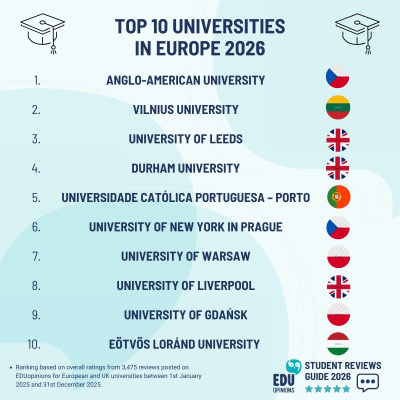
The University of Gdańsk was among the 10 best-rated universities in Europe, ranking 9th in the EDUopinions 2026 ranking, based on the opinions of students and graduates collected throughout 2025. UG is one of only two Polish universities included in the ranking, alongside the University of Warsaw.
The EDUopinions ranking is unique in that it is based exclusively on authentic reviews from students and graduates of various fields of study, both full-time and part-time. The assessment covered, among other things, the quality of education, academic and administrative support, the atmosphere on campus and the overall educational experience.
‘High positions in renowned rankings, such as the Perspektywy ranking or the QS World University Rankings, which are based on scientific, publication and internationalisation indicators, confirm the strong position of the University of Gdańsk in Poland and worldwide,’ says Rector Prof. Piotr Stepnowski. ‘However, we are particularly pleased that the students themselves appreciate our university not only as a place of learning, but also as a supportive academic community.’
The ranking presents 10 universities and was compiled by analysing all EDUopinions reviews published between 1 January and 31 December 2025.
‘The presence of the University of Gdańsk among the best-rated European universities in a ranking based on student opinions is particularly important for us in the context of the international community. We make every effort to ensure that our international students feel at home at the University of Gdańsk,’ sums up the Vice-Rector for Cooperation and Internationalisation, dr hab. Anna Jurkowska-Zeidler, prof. UG. ‘The ranking confirms that students from different countries find an open, inclusive and friendly environment at UG, conducive to learning, intercultural cooperation and academic development in an international dimension.’
The University of Gdańsk not only employs outstanding academic staff who are successful in their research and obtain multi-million pound grants, but also continuously improves the teaching skills of its employees, including through tutoring projects and workshops on working with young people. UG is developing its educational offer by establishing new fields of study, such as Japanese studies and historical game design, and expanding its range of postgraduate studies that meet the needs of the labour market and are related to the development of new technologies, such as Education for Sustainable Development: Offshore Wind Energy. The university also offers truly international studies - programmes run jointly with foreign partner universities as part of the European consortium of coastal universities SEA-EU.
‘This distinction confirms that our chosen strategy of education and student support is bringing real results,’ says Vice-Rector for Student Affairs dr hab. Urszula Patocka-Sigłowy, prof. UG. ‘We care not only about study programmes, but also about student welfare, accommodation conditions, and cultural and sports activities. We are here for them and we are glad that they appreciate it.’
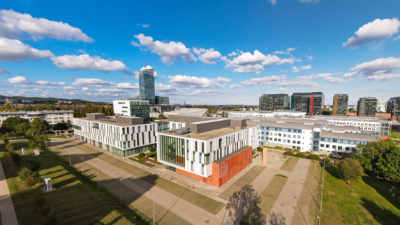
Thanks to the expansion of three campuses - primarily in Oliwa, but also in Sopot and Gdynia - the university offers young people the opportunity to study in modern buildings and laboratories. Student halls of residence are being gradually renovated, and the reconstruction and modernisation of Student Hall of Residence no. 9 in Sopot will begin soon. The university also plans to build new student halls on Wita Stwosza Street. At the moment, intensive work is underway in Oliwa on the largest investment project to date - the UG Sports Centre, which will primarily serve students affiliated with the UG University Sports Association, who are successful in academic sports.
The Oliwa campus will also see the creation of a cultural centre for students who are active in the Academic Cultural Centre, which includes the University of Gdańsk Academic Choir, the Jantar Song and Dance Ensemble, the Academic Orchestra, the Vocal Studio and theatre groups. An Academic Psychological Support Centre has also been established for students, set up after the pandemic in response to growing mental health needs, with the aim of strengthening mental resilience and systematically caring for the health and well-being of students.
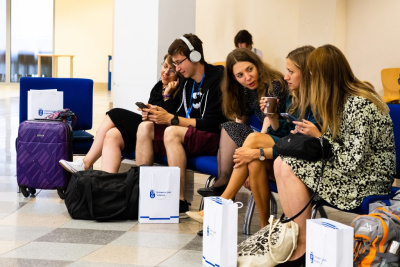
The Student and Doctoral Student Activity Centre supports the activities of students and doctoral students: ‘All CASiD activities are related to the well-being of students and doctoral students, in accordance with the intention of His Magnificence, who established the unit in 2021,’ says CASiD Director mgr Łukasz Bień. ‘We provide administrative services to student and doctoral self-government bodies. We support the activities of research clubs and student and doctoral organisations in terms of organisation and promotion. We carry out and support research on student subjectivity, both in historical and contemporary terms. Thanks to these activities, we have managed to obtain a grant from the National Agency for Academic Exchange PROM, whose main beneficiaries are students and doctoral students.’
The scope of CASiD's interests is very diverse, which results both from the large number of students (approx. 22,000) and from the fact that the university brings together many areas of science and, as a result, its community is very diverse and has very diverse needs: ‘We work to promote student culture by organising many entertainment and cultural events at the University of Gdańsk and beyond. We carry out social and charitable activities, which are initiated and implemented by students and doctoral students,’ says the Director of CASiD. ‘We also conduct surveys and opinion polls and listen to the voices of students and doctoral students. We believe that there are no stupid questions or ideas that should not be heard. We support and initiate systemic activities related to optimising access for students and doctoral students to the university's infrastructure. Material issues are important, which is why we support the activities of the University Accommodation Committee and the University Scholarship Committee. It is very important to help students and doctoral students with their individual problems concerning living conditions or the education process. It is students and doctoral students who are the primary focus of our activities, and we try never to forget that.’
The university also supports the scientific ambitions of young people by organising, for example, the Young Science Congress, which every year brings together students and doctoral students from all over Poland to share their research and scientific passions. ‘It provides a unique opportunity to present research results and discuss them in a friendly but competent group. Conference participants, but not only them, can publish their research results in ProgressMagazine. The journal, which is part of the CASiD structure, is addressed to young scientists, mainly students and doctoral students,’ adds Łukasz Bień.
The EDUopinions 2026 ranking presents the opinions of students and graduates on its website. Reading them, one can see how different aspects of academic life students pay attention to.
Among the positive opinions, the most frequently praised are the university lecturers (‘helpful professors’) and the teaching atmosphere, the high level of expertise combined with kindness and the lack of hierarchical distance. The quality of classes is described as interactive and practical (especially in programmes taught in English). Respondents also appreciated, among other things, small groups and real contact with lecturers.

UG benefits from its location, which students clearly appreciate, emphasising the peaceful atmosphere conducive to learning and rating the university campus as friendly. The city of Gdańsk itself, described as beautiful and a good place to live, is also important.
Critical comments most often concern administrative organisation: changes in plans, bureaucracy, unclear communication and differences between departments, as well as the structure of programmes, which some consider to be too theory-based.
‘Students and graduates give the highest marks to support for international students (welcome centre, administration), the quality of teaching from the user's perspective, the atmosphere, integration, student life and living costs. This perception of the university by foreign students is largely due to our Welcome Centre and the building of a Welcome Culture,’ adds Vice-Rector prof. Anna Jurkowska-Zeidler. (Welcome Centre website)
The high position in the EDUopinions 2026 ranking is a strong recommendation for those considering studying at the University of Gdańsk. For international partners, it confirms that UG is one of the best-rated universities in Europe - according to those who know it first-hand.
Ranking website - see here.