
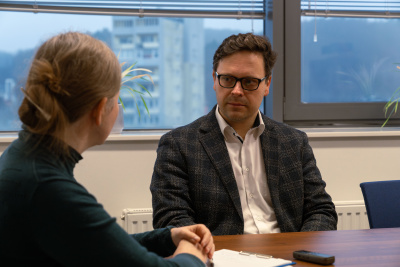
Pragmatism and diversity - these are the terms we can use when talking about the more than 300 voices from local governments in the European Union that make up the European Committee of the Regions. What is the role of the Committee and its impact on European legislation? Is the voice of the regions heard, and should it be heard in the EU - and why? We discussed this with dr hab. Jakub Szlachetko, prof. UG, Head of the Centre for New Technologies Law at the University of Gdańsk and expert at the European Committee of the Regions.
Karolina Żuk-Wieczorkiewicz: - You recently became an expert of the European Committee of the Regions. What will your role be?
Dr hab. Jakub Szlachetko, prof. UG: - I will support the members of the European Committee of the Regions in their advisory processes. I am currently working with Magdalena Czarzyńska-Jachim, Mayor of Sopot, who represents Polish regional and local authorities in the Committee of the Regions. The expert work basically boils down to drafting and consulting on draft opinions through which the Committee of the Regions has a say in European Union policy and legislation. These opinions are important because they represent the position of local government, regions, metropolises and smaller towns in the Union's decision-making process. They are then forwarded to the European Commission and other EU institutions and serve as a reference point in discussions on the shape of individual policies and, ultimately, legislation.
- Am I right in understanding that this is about the region's voice in EU legislation?
- That's right. The European Union is a large and diverse entity, represented by different levels of government. In addition to the countries that are represented in the Council of the European Union and the citizens who are represented in the European Parliament, there are also local governments, which work tirelessly every day to improve the quality of life of their residents. They play a very important role in the Member States of the European Union, because they are responsible for performing most of the tasks entrusted to them by the legislator: both the European one, i.e. the European Union, and the national one - in our case, the Republic of Poland. It is therefore important that the voice of local government is heard in these processes, and this is what the Committee of the Regions is for.
- How does the Committee of the Regions work?
- The European Committee of the Regions has been operating since 1994. It was reformed under the Treaty of Lisbon in 2007 and gained greater powers at that time. The Committee operates primarily through opinions, which are expressions, declarations, and attempts to influence legislation. Its mission is to uphold the principle of subsidiarity, which should form the basis for the construction of the Union.
- So I understand that the European Committee of the Regions is an advisory body.
- Exactly. It is not a decision-making body. The key decision-making bodies involved in law-making are the European Commission, the European Parliament and the Council of the European Union. The others are of a different nature, e.g. advisory or consultative. The two most important advisory bodies are the European Committee of the Regions, which represents the voice of the territory, and the Economic and Social Committee, which in turn represents entrepreneurs, business associations and employers' organisations. I work for the Committee of the Regions.
- I understand that this is an attempt to bring the European Union closer to citizens at the local level.
- Yes, it is. Citizens are, of course, represented in the European Parliament, but each MEP has a very large constituency. Yes, they have a strong mandate and a lot of support, but the relationship between MEPs and their constituents is very loose. On the other hand, those who do most of the day-to-day work for the benefit of residents are local governments, municipalities, counties and provinces in Poland - and their counterparts in other countries. Their role is often underestimated. In my opinion, it is precisely this voice, which is usually very pragmatic, that should be heard loud and clear in the European Union.
- Why?
- According to statistics from the European Committee of the Regions, local government implements around 70% of European law, which is the vast majority. So, who should we listen to if not those who then apply the law? Who knows best what the shortcomings of this law are, where there is ‘over-regulation’ and where there is ‘under-regulation’? That is why it is important for local government to be heard. The European Committee of the Regions consists of 329 members. They represent the territories of the European Union, those between citizens and national governments. What is also important in the context of the Committee is diversity. The European Union is diverse - not only at the level of nations, but also in terms of smaller territories, regions, metropolises and various localities. Local government is also the force that shows how different we are. And for me, this is a very interesting mix. Parliamentarians and government politicians fight for issues that are socially controversial and try to influence in a zero-sum way in order to build their own support. Local government officials focus on something else: providing residents with roads, water, schools and social assistance. Of course, this can also be polarising, but it is a different level of pragmatism and there is not much room for ideology. This is what fascinates me about the European Committee of the Regions: this pragmatism with diversity, because there are 329 mayors, city presidents and marshals from across the European Union. It is a very interesting contrast.
- That sounds like a very big challenge: to draft legislation in such a way that it can work in a diverse environment.
- It is a challenge, especially since there are different factions present in the European Union - those we see in the media and those that are less visible. There are lobby groups, a whole jungle of different institutions and interests. The Union itself is highly bureaucratic - and it is also interesting that the first topic I raised in my work at the European Committee of the Regions is so-called simplification.
- Could you say more about this? I understand that simplification means simplifying, for example, regulations or procedures.
- Exactly. The word doesn't sound very good in Polish, but it has become accepted. So the first goal is to simplify the functioning of the European Union. On the one hand, it is about simplifying the structure of EU power. We also want to ‘downplay’ what everyone in the European Union laughs at, namely the famous ‘banana shape regulation’. There are more such proverbial ‘bananas’ in EU legislation. The point is therefore to create ‘less law’ and to revise the existing law so that it is not so extensive.
Scientific literature refers to legal inflation, which is simply a difficult phenomenon at the European Union level. If the European Union wants to be competitive on a global scale, if it is to compete economically with, for example, China, the United States or other countries, it must create favourable conditions for business development, university development, etc. With the current jungle of regulations, this is becoming increasingly difficult. The aim of the committee in which I participate is therefore to express a position on what a ‘simplified’ European Union should look like in a few years’ time. These are difficult and complex processes, spread out over time.
- Are you able to say anything about the progress of the work at this stage, or is it still too early?
- Our opinion will be presented at the plenary session in December, when it will be discussed and adopted. At this stage, I can say that we are dealing with a very broad issue, because simplification can in fact affect every segment of the European Union. Our opinion is based on several key chapters. The first concerns legislation, the creation of law. We want a stronger territorial approach to those entities that subsequently apply European law, i.e. (among others) local authorities.
The second area concerns fund management, which is probably the hottest topic currently sweeping through the European Union. There is a struggle between different groups over how the European Union should function in the new budgetary perspective, where the slider should be moved on the centralisation-decentralisation axis in terms of fund management. The European Commission has proposed a slightly more centralised system, while local government naturally prefers a more decentralised model, in which its role is stronger not only in the application of regulations, but also in the creation of regulations and programmes.
The third important area of opinion is programming. Once we have a fund management system in place, we need to know what these funds will be used for and through which programme documents they will be implemented.
The fourth issue is public procurement. This is also complicated because there are many public procurement systems: there are national systems and there is a European system. All this hinders the functioning not only of the European Union administration itself, which is probably most familiar with it, but also hinders the work of entrepreneurs, universities and social organisations that want to apply for funding.
- Given the maze of regulations, many small entities in particular may decide not to apply for funding.
- Many small non-governmental organisations, many small municipalities or towns do not have the human and financial resources to navigate all these regulations, which means they miss out on further competitions and opportunities. The point is, therefore, that the system should be tailored to the needs of different beneficiaries, not just those who have the staff, know-how and experience to operate relatively efficiently.
Another area is digitalisation. So, to sum up, the key issues we raise in our opinion are legislation, funding, programming, public procurement and digitalisation. We are looking for optimal solutions in each of these areas. At this stage, we are preparing a policy document, which will then be discussed, processed and perhaps implemented in part through specific legal acts.
- What real influence does the Advisory Committee have on European Union decisions?
- That is a very good question, perhaps less for a lawyer and more for a sociologist. Judging by the decisions taken by the European Commission, it is clear that it takes such organisations into account. Their opinions exert pressure, and the European Commission is capable of yielding to this pressure. It may not radically change its mind, but in some areas it can give way and seek compromise. I have the feeling that European politics is definitely more about building compromises and pragmatic alliances for specific solutions than our national politics, where the situation is more or less black and white and whoever has a mathematical majority ‘takes everything’. In the EU, this dialogue and the attempt to find solutions that lie somewhere in between looks a little different (even if not perfect). Therefore, an opinion (for example, that of the European Committee of the Regions) does not have to be binding, it does not directly decide anything, but...
- Is it taken into account?
- Exactly. The European Committee of the Regions is a powerful organisation because it represents several hundred local government units: regions, provinces and metropolitan areas. These are institutions that are important in economic, population, demographic and management terms, and therefore cannot simply be ignored. The Committee's opinion hence becomes a point of reference, an argument in the debate. It creates pressure, and how effective this opinion will prove to be remains to be seen.
However, it is clear that there is a strong drive for simplification in the European Union and its various bodies, including the European Commission. We are all aware that both the citizens and the European Union as a supranational organisation in the global system need simplification, because otherwise we will not be able to cope with our bureaucracy, “over-regulation” or legal inflation.
- I understand that simplicity of regulations is essential if we want to be competitive.
- Definitely yes. The simplification process was a very important item on the agenda of the Danish Presidency, which strongly emphasised the need to address this issue seriously. The European Commission is already taking action, with the introduction of so-called omnibus bills, or deregulation packages. This is, of course, only the beginning. We still have a long way to go before the EU actually achieves greater efficiency and effectiveness in relation to the simplification we are discussing.
- What are your hopes for the work you are doing?
- It is difficult to talk about great hopes. I simply approach my tasks with great interest. In my professional career to date, I have dealt with the decentralisation of power, local government, development policy and spatial planning, so the subject of local government was in some way close to my heart. Now, however, I am dealing with a new perspective, which is incredibly interesting because I have an insight into local government, but from a bird's eye view. In addition, I can observe and analyse other local governments in other countries, which allows me to learn a lot. If I can contribute something to the whole project, it is an additional source of satisfaction.
So, it is an interesting adventure from which I hope to gain a lot, and I hope that it will result in interesting publications or new documents. In Poland, I deal with local government legislation, among other things, and I coordinate several bills at the government level - and I hope to use my EU experience in my work on Polish law as well.
- In that case, I wish you the best of luck with this experience. Thank you for talking to us!
Official website of the European Committee of the Regions.